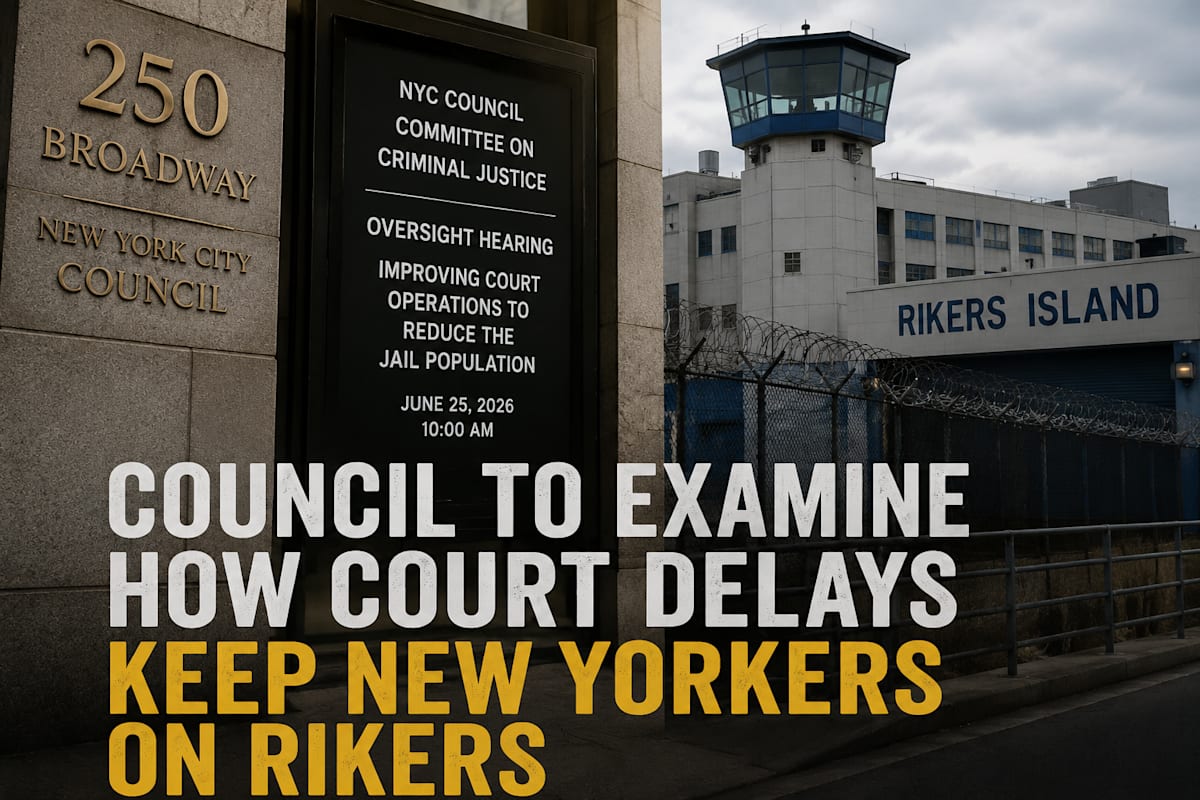
City Council to Examine How Court Delays Keep New Yorkers on Rikers
qftivr4px0lvb3em3ppt2hrjztal2.53 MBCity Council to Examine How Court Delays Keep New Yorkers on Rikers
By Michele Evans New York City, New York 6/22/2026
Category: Courts / criminal Justice / City Hall
NEW YORK CITY, NY - New York City lawmakers are set to take up a question that sits at the center of the Rikers crisis: how much of the jail population is being driven not by new crime, but by delay.
The City Council’s Committee on Criminal Justice is scheduled to hold an oversight hearing Thursday titled “Improving Court Operations to Reduce the Jail Population.” The hearing is set for June 25 at 10 a.m. at 250 Broadway.
The topic cuts directly into one of the most persistent problems in New York City’s criminal justice system. People detained pretrial can remain on Rikers Island for months or even years while cases move slowly through the courts. Each adjournment, missed production, discovery dispute, delayed evaluation, unavailable attorney, or administrative breakdown can add more time behind bars before a case is ever resolved.
For people held on Rikers, those delays are not abstract. They mean more days in a jail system repeatedly criticized for violence, medical neglect, staffing shortages, missed services, and dangerous conditions.
The hearing also comes as city officials continue to face pressure over the future of Rikers Island and the city’s ability to reduce the jail population enough to move toward borough-based jails. But population reduction is not only about arrest numbers or sentencing policy. It is also about whether the courts can move cases efficiently, whether detainees are produced for required appearances, and whether agencies coordinate well enough to prevent people from sitting in custody because the system itself failed to function.
Court operations may sound technical, but the stakes are human.
When a person is detained pretrial, every delay can affect housing, employment, family stability, medical care, legal strategy, and mental health. For defendants with health conditions, trauma histories, or serious psychiatric needs, time inside can make an already fragile situation worse. For families, delays mean uncertainty. For attorneys, delays can weaken preparation. For the city, every unnecessary jail day adds cost, pressure, and risk inside an already strained system.
The hearing is expected to focus attention on how court processing, case scheduling, agency coordination, and jail production issues contribute to the size of the city’s detained population.
The question for lawmakers is not simply how many people are on Rikers.
It is how many are there because the machinery of justice is moving too slowly.
That question matters because Rikers is not just a jail. It is where the consequences of every delay land.
Thursday’s hearing gives the Council an opportunity to press city and court stakeholders on what is actually causing cases to stall, what data exists to track those delays, and what reforms could safely reduce the number of people held in custody while awaiting resolution.
For New Yorkers watching the Rikers crisis, the hearing may offer a clearer view of a problem often hidden behind courtroom calendars and procedural language.
Behind every adjournment is a person waiting.
Behind every missed production is another day in custody.
And behind the jail population numbers is a court system whose pace can determine who goes home, who stays locked up, and how long justice takes.
*Michele Evansis an independent journalist, author, and former ESPN technical producer whose work has appeared in The New York Times.
Michele got her start in 2001 covering the NBA and NFL.
She now covers New York City courts, criminal-justice procedure, NYPD, FDNY, domestic-violence systems, media accountability, public safety, advocacy efforts, and New York civic life through courthouse observation, public records, legal analysis, and lived-experience reporting.