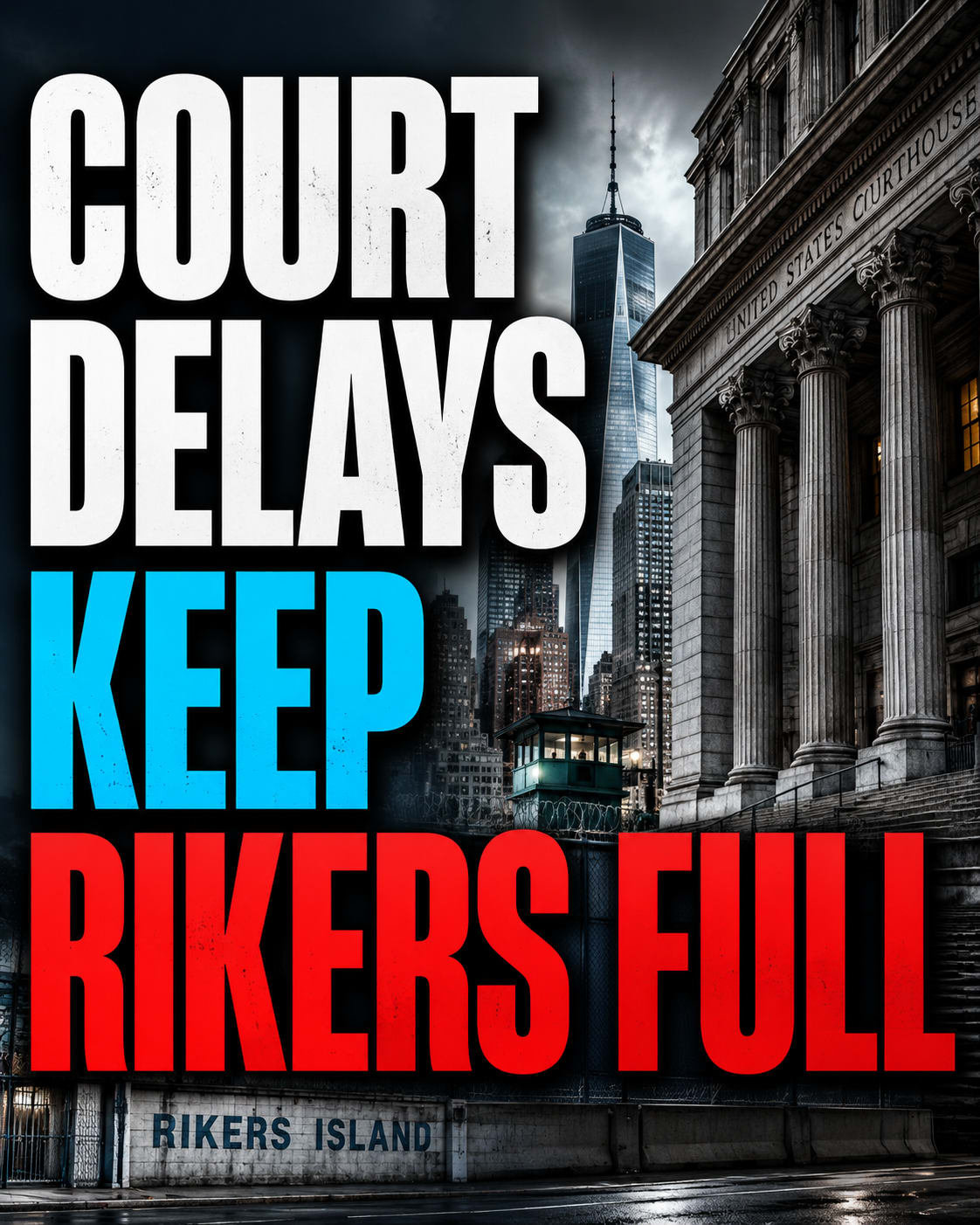
City Council Is Finally Looking at the Court Delays Keeping Rikers Full
12np6u94wba56bglasablitquyf02.1 MB City Council Is Finally Looking at the Court Delays Keeping Rikers Full
By Michele Evans New York City, New York 6/10/2026
Category: Courts / Criminal Justice / Rikers Island
New York City, New York - New York City keeps talking about closing Rikers.
But one of the biggest questions is not just what happens inside the jail.
It is what happens before people ever get there, and why so many people stay there so long.
On June 25, the New York City Council Committee on Criminal Justice is scheduled to hold an oversight hearing on “Improving Court Operations to Reduce the Jail Population.”
That may sound dry.
It is not.
This is one of the central questions behind the future of Rikers Island: if the courts do not move, the jail population does not move either.
People love to argue about Rikers as if the jail exists in isolation. It does not. Rikers is the final stop in a system built by police, prosecutors, defense attorneys, judges, court calendars, discovery disputes, adjournments, transportation problems, mental health shortages, and bureaucratic delay.
When that system slows down, people do not just wait on paper.
They wait in jail.
They wait in intake.
They wait in dorms.
They wait in cells.
They wait through lockdowns, medical delays, violence, missed programming, family separation, and the psychological grind of not knowing when their case will actually move.
And many of them are legally presumed innocent while they wait.
That is the part New York needs to stop skipping over.
The city can build new jails. It can rename facilities. It can hold press conferences. It can announce reform plans. It can promise a safer, smaller, more humane system.
But if court delays keep pushing the jail population up, the math does not work.
The Comptroller’s Office has already warned about this. Court case processing times have grown worse in recent years, and those delays are helping drive the jail population higher. The report found a 179 percent increase from 2019 to 2023 in felony cases involving people in Department of Correction custody that took more than three years to process.
Three years.
That is not a calendar problem.
That is a life problem.
It is also a taxpayer problem. The same report estimated that improving case processing in line with national best practices could save New York City up to $877 million a year.
That number should stop everyone cold.
Because when people talk about Rikers, they often talk about public safety and human rights as if they are separate from money. They are not. Every unnecessary month a person spends in city custody costs money. Every delayed case costs money. Every avoidable jail bed costs money. Every failure to coordinate the courts costs money.
And the human cost is even worse.
Rikers is not a waiting room. It is one of the most dangerous jail systems in the country. Waiting there is not neutral.
A delayed court date can mean another month exposed to violence.
A missed production can mean another month away from children.
A discovery fight can mean another month without treatment.
A scheduling failure can mean another month of trauma for someone who has not been convicted of anything.
This is why the June 25 hearing matters.
The question should not be whether the courts are busy. Everyone knows they are.
The question is whether New York City is willing to treat court delay as a jail population driver, a public safety issue, a fiscal emergency, and a human rights failure all at once.
The city’s Rikers closure plan depends on reducing the number of people in custody. But the jail population remains far above what the borough-based jail plan can realistically absorb. The Comptroller’s DOC dashboard listed the jail population at 6,805 as of March 2, 2026, while the city’s borough-based jail plan has been tied to a much smaller future system.
That gap is not cosmetic.
It is the whole problem.
If New York cannot reduce the jail population, it cannot honestly claim it is on track to close Rikers in any meaningful way.
And reducing the jail population cannot only mean arguing about bail. It has to mean looking at the machinery of the courts.
How many cases are delayed because discovery is not ready?
How many people are sitting because transportation failed?
How often are people produced late or not produced at all?
How many adjournments are avoidable?
How many cases are stuck because agencies do not communicate?
How many people with mental illness are being held because treatment pathways are too slow, too confusing, or simply unavailable?
How many people are sitting in jail not because their case is complicated, but because the system is?
Those are the questions City Council should ask.
And they should ask them plainly.
Because anyone who has lived inside Rikers knows the court calendar is not some abstract legal document. It is the thing people stare at, pray over, argue about, cry about, and build their survival around.
Court dates become hope.
Then they become disappointment.
Then they become another month.
Then another.
Then another.
New York cannot fix Rikers without fixing the delay machine that feeds it.
The June 25 hearing should not become another polite government conversation about operational challenges and interagency coordination.
It should be a reckoning.
If the courts are helping keep Rikers full, then court operations belong at the center of the Rikers conversation.
Not as a side issue.
Not as a technical issue.
As the issue.
Because the jail population is not just a number.
It is thousands of people waiting inside a system New York already knows is broken.
*Michele Evansis an independent journalist, author, and former ESPN technical producer whose work has appeared in The New York Times.
Michele got her start in 2001 covering the NBA and NFL.
She now covers New York City courts, criminal-justice procedure, NYPD, FDNY, domestic-violence systems, media accountability, public safety, advocacy efforts, and New York civic life through courthouse observation, public records, legal analysis, and lived-experience reporting.