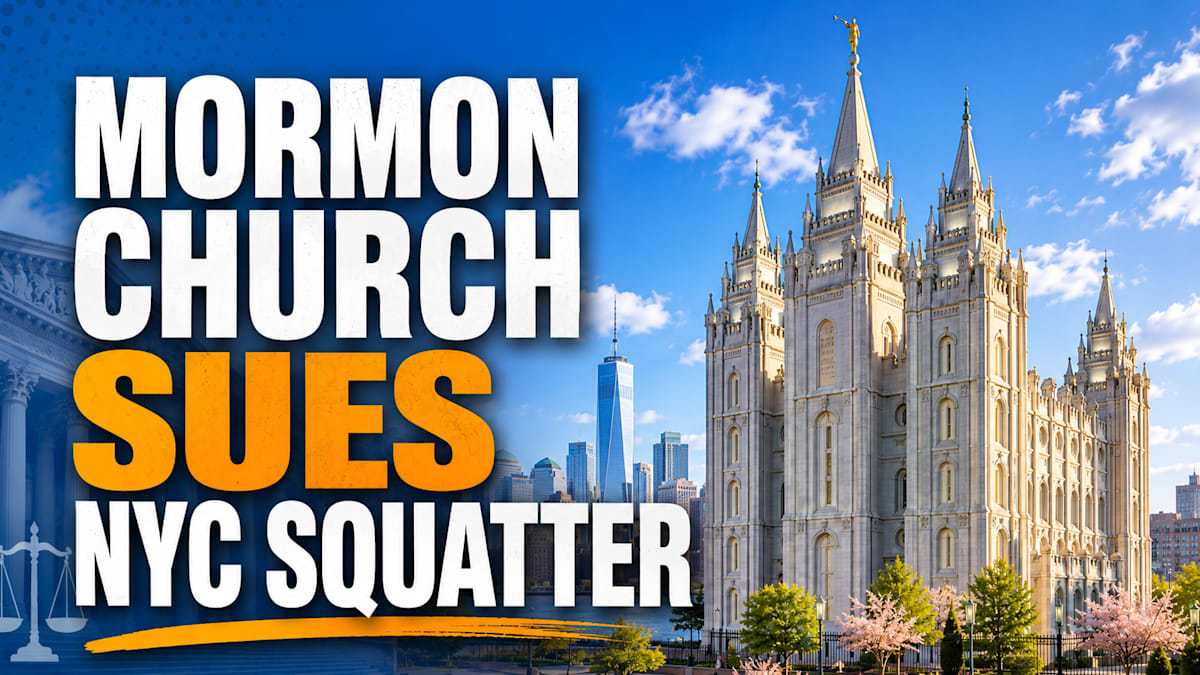
A Mormon Squatter Story, a Manhattan Lawsuit, and the Strangest Full-Circle Pioneer Moment in New York
ap04wcyiighs2rqv9l1cbnp74lsf2.15 MBA Mormon Squatter Story, a Manhattan Lawsuit, and the Strangest Full-Circle Pioneer Moment in New York
By Michele Evans New York City, New York 6/4/2026
Category: Courts / Civil / Church
New York City, New York - Only in New York can a church founded in the 1800s end up in Manhattan Supreme Court because a man allegedly turned its chapels into his personal hide-and-seek Airbnb.
The Church of Jesus Christ of Latter-day Saints says Edwin A. Pabon repeatedly entered locked church buildings in Queens and Manhattan, stored belongings inside, used kitchens, bathrooms, and showers, and slept in tucked-away spaces including an attic, crawl spaces, an office, and even a chapel stage.
Which, to be fair, is one way to interpret “come unto Christ.”
The church, however, appears to have preferred “come during posted service hours.”
The filing says Pabon was baptized into the church in 2007 and was formally barred from church property in January, except for Sunday services. But according to the suit, he kept coming back. Church officials now want a permanent restraining order.
On the surface, this is a very New York story: locked buildings, strange access, alleged trespassing, a court filing, and a man apparently treating sacred real estate like a series of emergency crash pads.
But because this is a Mormon story, it also comes with history.
And that history makes this whole thing oddly poetic.
The Church of Jesus Christ of Latter-day Saints was formally organized in 1830 in Fayette, New York. Before it became a global institution with temples, chapels, genealogical vaults, public affairs departments, and attorneys filing Manhattan lawsuits, it began as a small, strange, controversial, and deeply persecuted religious movement in upstate New York.
That early story runs directly through families like mine.
Joseph Smith, the founder of the Latter-day Saint movement, had close ties to the Knight family in Colesville, New York. Joseph Knight Sr., one of my ancestors, was one of Smith’s earliest supporters. Smith lived and worked for Knight just before the formal organization of the church. Knight hired him, housed him, believed him, and provided material support while Smith was working on the translation of the Book of Mormon.
In other words, before there were temples, tabernacles, missionaries, family-history centers, and church lawyers, there was a young Joseph Smith in upstate New York depending on early believers like the Knights.
The Knight family did not just watch Mormon history happen from the sidelines. They helped make it possible.
Then, like so many early Saints, they paid for it.
The Colesville Saints would follow the movement westward as pressure, hostility, and violence pushed early Mormons from place to place. They did not get to stay put. They were driven from New York to Ohio, from Ohio to Missouri, from Missouri to Illinois, and eventually across the plains.
The survivors ended up in the Salt Lake Valley, which at the time was not even part of the United States. It was Mexican territory before the Treaty of Guadalupe Hidalgo brought it under U.S. control.
So yes, there is something wildly full-circle about the Mormon Church, born in New York, helped along by families like mine, pushed west by persecution, now returning to New York courts to push out a man allegedly sleeping inside its chapels.
History has jokes.
The early Saints were chased out of communities.
Now the modern church is asking a court to chase someone out of its buildings.
That does not mean the church has no right to secure its property. It does. Houses of worship need to be safe. Members, children, staff, volunteers, and visitors have a right to know who is inside the building and why. Hidden sleeping arrangements in attics and crawl spaces create serious safety, liability, and security concerns.
But it also raises the uncomfortable question sitting under the floorboards of this whole case:
What does it say about New York when someone is allegedly desperate enough, determined enough, or disconnected enough to keep sneaking into church buildings to sleep?
The tabloid version is easy.
Weird squatter. Church mouse. Attic napper. Sneaky trespasser.
The more interesting version is harder.
A man sleeping inside a chapel attic is not just a punchline. It is a housing story. It is a mental-health story. It is a public-space story. It is a religious-institution story. It is also a very New York story about what happens when private property, desperation, and spiritual language collide.
Churches often preach refuge.
But refuge has locks.
Refuge has insurance policies.
Refuge has security cameras.
Refuge has attorneys.
And when someone crosses the line from worshipper to trespasser, grace can turn into litigation real fast.
That is the tension here.
The Latter-day Saint tradition carries a pioneer memory built around movement, exile, survival, and refusal to disappear. Its earliest members knew what it meant to be watched, mistrusted, displaced, and told to move along.
That history does not erase the church’s right to protect its buildings. It does, however, make this lawsuit feel stranger than an ordinary trespass case.
Because the image is almost too on-the-nose: a church born from people who once had nowhere secure to land is now asking a New York court to remove someone who allegedly kept trying to make its chapels into shelter.
Different facts. Different power. Different century.
But the question under the floorboards is familiar:
Who gets refuge, who gets removed, and who gets to decide when welcome has expired?
That is what makes this more than a quirky attic story.
Yes, it is funny. A man allegedly popping up in Mormon church crawl spaces like a pioneer-era raccoon is objectively absurd.
But it is also revealing.
New York is full of locked doors, empty rooms, desperate people, and institutions with missions painted on the wall. Every so often, one strange lawsuit cracks open something bigger than the headline.
This one starts with an alleged chapel squatter.
It ends with a church that once fled New York returning to court in New York to say: this person has to go.
That is not just irony.
That is a full-circle Mormon event.
Somewhere, the pioneer ancestors are either laughing, whispering, or checking the locks.
*Michele Evansis an independent journalist, author, and former ESPN technical producer whose work has appeared in The New York Times.
Michele got her start in 2001 covering the NBA and NFL.
She now covers New York City courts, criminal-justice procedure, NYPD, FDNY, domestic-violence systems, media accountability, public safety, advocacy efforts, and New York civic life through courthouse observation, public records, legal analysis, and lived-experience reporting.