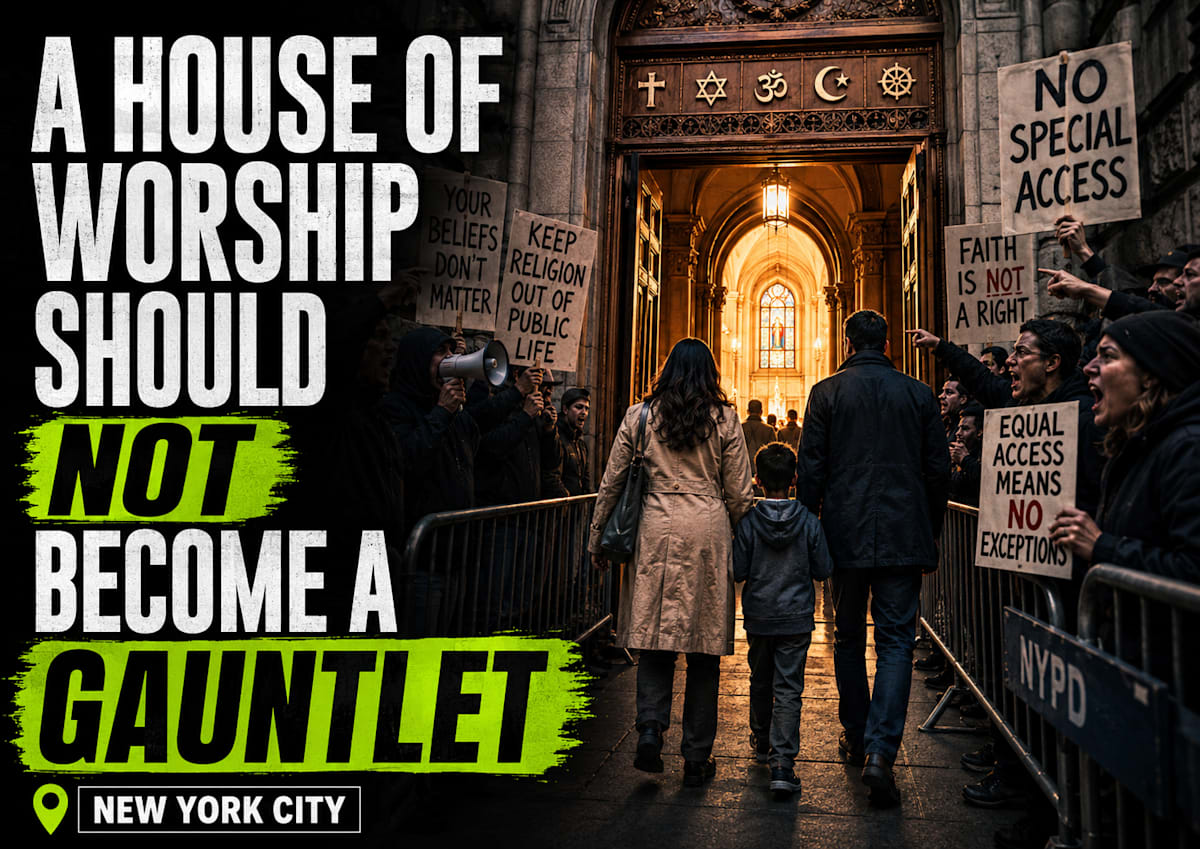
8xjpl7kn9npmfj96jrpo6g38pu4h2.37 MBA House of Worship Should Not Become a Gauntlet
New York is moving to protect access to houses of worship. The victim-centered question is simple: who gets to pray without being surrounded, blocked, screamed at, or made afraid?
By Michele Evans New York City, New York 7/1/2026
Category: Politics / City Hall / Public Interest
NEW YORK CITY, NY - There are places where the First Amendment must be protected with enormous care.
The street is one of them.
A protest line is one of them.
A public sidewalk is one of them.
But so is the doorway of a house of worship.
That is the place where the constitutional conversation too often loses the victim. The debate becomes government power versus protest rights, police discretion versus civil liberties, buffer zones versus free speech. All of that is real. All of that deserves scrutiny. But the person trying to walk into a synagogue, church, mosque, temple, chapel, ward, meetinghouse, or sanctuary is also standing inside the Constitution.
They are not a prop in someone else’s demonstration.
They are not a captive audience.
They are not an acceptable casualty of political theater.
New York City’s Schools and Houses of Worship Access and Safety Act requires the NYPD to develop and publicly post response plans for protests outside schools or houses of worship when there is risk of physical obstruction, injury, intimidation, or interference. The City Council described the legislation as a transparency and safety measure that must also preserve the rights to free speech, assembly, and protest.
That balance is the whole fight.
Because religious intimidation is not abstract. It is not a footnote. It is not only something that happened “back then” or “somewhere else.” For Jewish New Yorkers facing a documented rise in antisemitic incidents, for Muslims targeted after every geopolitical crisis, for Christians whose sanctuaries become political battlegrounds, for Latter-day Saints who carry a history of being driven, threatened, mobbed, and expelled across the American frontier, the doorway of worship can carry centuries of memory.
No one should have to calculate personal safety before entering a sacred space.
No one should have to decide whether prayer is worth walking through a hostile crowd.
No child should have to pass people screaming outside a school or religious building and be told later that the adults were simply “exercising rights.”
Rights do not become more sacred when they are used to make someone else afraid.
The victim-centered frame is not anti-protest. It is pro-human being. It asks what the person entering the building experiences in their body. Were they blocked? Were they followed? Were they surrounded? Were they threatened? Were they filmed at close range? Were they made to feel that their religion, ancestry, politics, identity, or community made them unsafe in public?
That is the line New York has to hold.
A protest aimed at a government policy is one thing. A protest that turns the entrance of a house of worship into a tunnel of intimidation is another. A city that cannot tell the difference is not protecting free speech. It is outsourcing fear to whoever can gather the loudest crowd.
New York State has also moved on this issue. Gov. Kathy Hochul signed legislation making it a crime to block access to, or intimidate people entering, houses of worship. The law allows police to establish security perimeters around houses of worship, while critics have warned that buffer zones can chill lawful protest.
Those critics should not be brushed aside.
Police discretion can be abused. Protest rights can be narrowed in the name of safety. A city with New York’s history should be careful anytime it gives the NYPD authority to manage speech near sensitive locations. There is a reason civil-liberties advocates are worried about no-speech zones, selective enforcement, and the possibility that unpopular protest could be pushed out of sight.
But caution cannot become paralysis.
The answer to possible overreach is not to abandon worshippers at the door.
The answer is strict transparency, narrow enforcement, clear standards, public reporting, and a bright line between protest and intimidation. Protesters should be able to speak. Worshippers should be able to enter. The government’s job is not to sanitize public disagreement. The government’s job is to prevent people from being trapped, blocked, threatened, or terrorized while exercising their own constitutional rights.
That is why this issue has to be discussed from the perspective of the person walking in.
Not the loudest organizer.
Not the politician looking for a press release.
Not the police department looking for broader discretion.
The worshipper.
The parent.
The child.
The elder.
The survivor.
The person who sees a crowd outside and feels their heart start to race.
The person who remembers that religious persecution usually begins with words, crowds, accusations, and public permission to treat believers as targets.
History does not require imagination here.
Mormon communities were driven from state to state. Jewish communities have carried generations of violence and exclusion. Black churches have been bombed. Mosques have been vandalized and surveilled. Sikh temples have been attacked. Religious minorities know what it means when a place of worship stops feeling like refuge and starts feeling like a target.
New York cannot claim to protect diversity while allowing sacred entrances to become pressure points.
The recent controversy involving Don Lemon shows how carefully these lines must be drawn. In Minnesota, an anti-ICE protest at a church led to arrests after demonstrators disrupted a worship service, while reports also raised questions about Lemon’s role as a journalist rather than a participant. The Associated Press reported that the protest led to arrests connected to obstruction of religious services and intimidation of attendees, while no charges were filed against Lemon. The Washington Post later reported that video appeared to contradict key allegations against Lemon, showing him primarily acting as a journalist by livestreaming and interviewing people.
That distinction matters.
Journalism is not intimidation.
Presence is not obstruction.
Reporting on a protest is not the same as blocking worshippers from entering or disrupting religious services.
But the underlying concern remains: when a political fight moves to the threshold of a sacred space, the law has to protect both the right to report and the right to worship. It has to separate the camera from the crowd, the journalist from the disruptor, the protest sign from the person physically preventing access.
A victim-centered law cannot become a censorship tool.
A free-speech law cannot become an intimidation shield.
That is the narrow bridge New York now has to walk.
The city should protect houses of worship because worshippers are human beings, not because any religion deserves special political immunity. Faith communities should not be insulated from criticism. Religious leaders can be questioned. Institutions can be protested. Policy positions can be challenged. But the doorway itself has to remain passable. The person entering has to remain safe.
A house of worship is not a hostage site for someone else’s message.
The deepest test of civil rights is not whether New York protects speech everyone likes. It is whether New York protects multiple rights at the same time, especially when they collide.
The right to protest.
The right to worship.
The right to report.
The right to enter without fear.
The right to be left physically unharmed while practicing your faith.
The right not to be surrounded at the door of a sanctuary and told your fear is simply the price of democracy.
That is not democracy.
That is coercion with a slogan.
New York should enforce these laws carefully, transparently, and narrowly. But it should enforce the basic principle without apology:
A person walking into a house of worship is not walking out of their civil rights.
They are walking into them.
*Michele Evansis an independent journalist, author, and former ESPN technical producer whose work has appeared in The New York Times.
Michele got her start in 2001 covering the NBA and NFL.
She now covers New York City courts, criminal-justice procedure, NYPD, FDNY, domestic-violence systems, media accountability, public safety, advocacy efforts, and New York civic life through courthouse observation, public records, legal analysis, and lived-experience reporting.