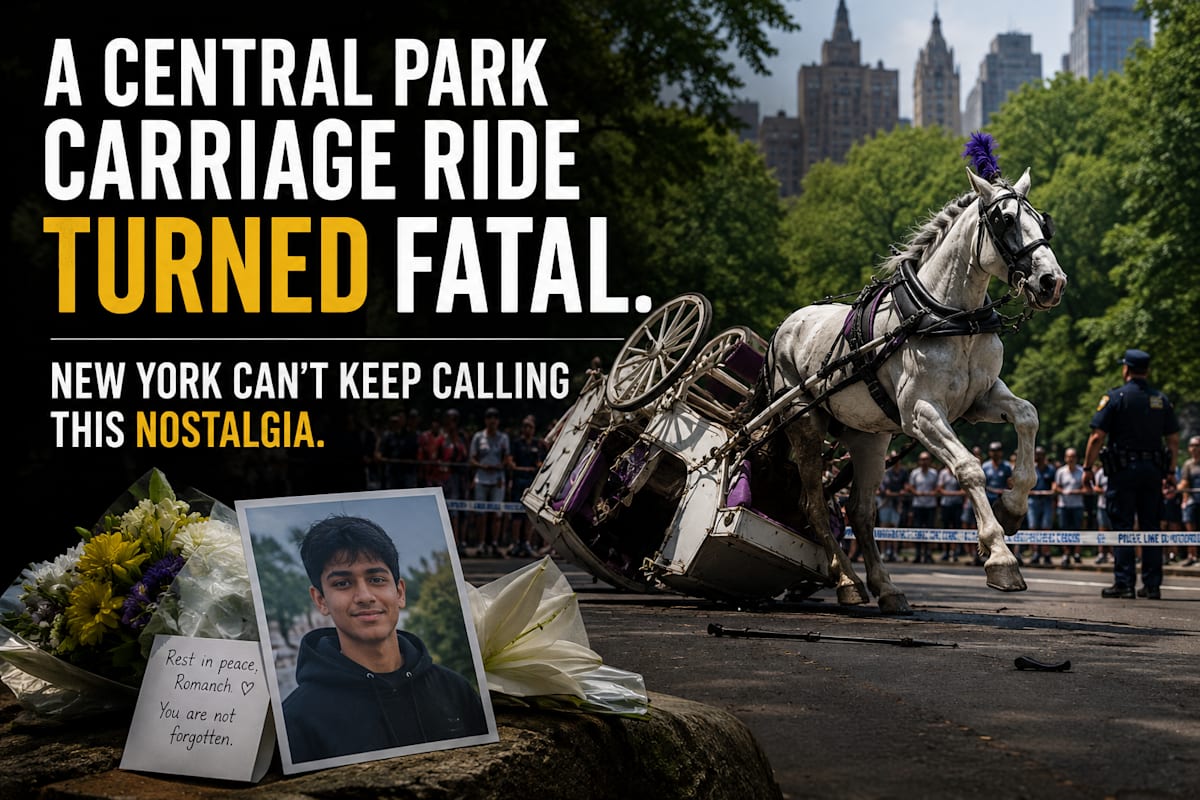
A Central Park Carriage Ride Turned Fatal. New York Can’t Keep Calling This Nostalgia.
bw7ny5de0w88qo4t82tbkwklmdcd2.35 MBA Central Park Carriage Ride Turned Fatal. New York Can’t Keep Calling This Nostalgia
By Michele Evans New York City, New York 6/18/2026
Category: Public Safety / Public Interest / City Hall
New York City, New York - An 18-year-old tourist came to Central Park for one of New York City’s most familiar postcard experiences.
His name was Romanch Mahajan. He was visiting from India with his parents and younger brother, reportedly on his first trip to New York City.
He left dead.
On Wednesday afternoon, a horse-drawn carriage ride in Central Park turned into a fatal public safety incident after a carriage horse bolted from its driver, sending passengers flying and ending with Mahajan suffering fatal head injuries.
According to reports citing his father, Deepak Mahajan, the family had stopped so the carriage driver could take their photo. Then the horse, Sampson, took off. Mahajan’s mother, Priya, fell from the carriage. His father said the teenager tried to help her before falling himself and striking his head on the pavement.
That detail changes the moral weight of the story.
This was not simply a freak accident in a city park. It was a family trip to New York that turned into a fatal trauma inside one of the most visited public spaces in America. A mother fell. A son tried to help her. A family that came to New York for a memory will now leave with the worst one imaginable.
For years, the debate over horse-drawn carriages in Central Park has been framed as a fight between nostalgia and animal welfare. Supporters call the carriages a New York tradition. Opponents call them cruel, outdated and unsafe.
After Wednesday’s fatal crash, that framing is no longer enough.
This is now plainly a public safety story.
Central Park is not a private carriage trail. It is a dense, crowded, heavily used public space filled with pedestrians, cyclists, pedicabs, runners, children, tourists, workers, police vehicles, maintenance vehicles and other horses. A frightened animal pulling a carriage through that environment is not a quaint image from old New York. It is a moving hazard.
And this did not happen in isolation.
Just over a week earlier, on June 9, a carriage horse collapsed and died in Central Park. That death immediately reignited calls to end the horse-drawn carriage industry in New York City.
The recent horse death also renewed the political fight over Ryder’s Law and the future of carriage horses in Central Park. Mayor Zohran Mamdani reiterated his support for banning carriage horses in Central Park after that death, while also saying the city should work with the drivers’ union so workers are not simply discarded.
That is the correct balance.
The city does not have to choose between protecting workers and protecting the public. It can do both.
The Transport Workers Union, which represents carriage drivers, has called for a full investigation. That investigation should happen. The driver’s conduct should be reviewed. The condition and training of the horse should be reviewed. The city’s inspection and enforcement history should be reviewed. Existing rules should be examined to determine whether they are being enforced or simply written down.
But investigation cannot become delay.
New York City already knows this industry presents risk. Past efforts to ban horse-drawn carriages have stalled, even as safety concerns, animal welfare concerns and the realities of modern park use have only grown more obvious.
The City Council also has legislation on the table. Ryder’s Law would prohibit the operation of horse-drawn cabs and phase out the industry. Other proposals would attempt reform instead of a ban.
Wednesday’s death sharpens the choice.
Reform means continuing to place horses, drivers, passengers and bystanders inside the same risk structure and hoping the next inspection, rule change or enforcement push prevents another disaster.
A ban means admitting the city has outgrown this practice.
That does not mean drivers should be abandoned. Many carriage drivers are working people, including immigrants, who depend on the industry for income. Any serious ban must include a real transition plan, not a press conference and a promise. Drivers should be offered pathways into other tourism, transportation, park or city-supported work. The horses should be retired safely and humanely.
But preserving jobs cannot require preserving danger.
New York City has retired many things once considered part of its character. The city changes when public safety, public health and basic decency demand it. We do not keep outdated practices alive simply because they look charming in photographs.
Romanch Mahajan came to New York with his family. He came to Central Park for an experience the city still markets, permits and normalizes. He died after that experience turned violent and uncontrollable.
That should be enough to end the city’s habit of treating this issue as a sentimental debate.
The question is no longer whether horse-drawn carriages are iconic.
The question is whether New York City is willing to wait for another horse to bolt, another carriage to flip, another worker to be injured, another tourist to die.
Central Park does not need carriage horses to be magical.
It does need to be safe.
*Michele Evansis an independent journalist, author, and former ESPN technical producer whose work has appeared in The New York Times.
Michele got her start in 2001 covering the NBA and NFL.
She now covers New York City courts, criminal-justice procedure, NYPD, FDNY, domestic-violence systems, media accountability, public safety, advocacy efforts, and New York civic life through courthouse observation, public records, legal analysis, and lived-experience reporting.