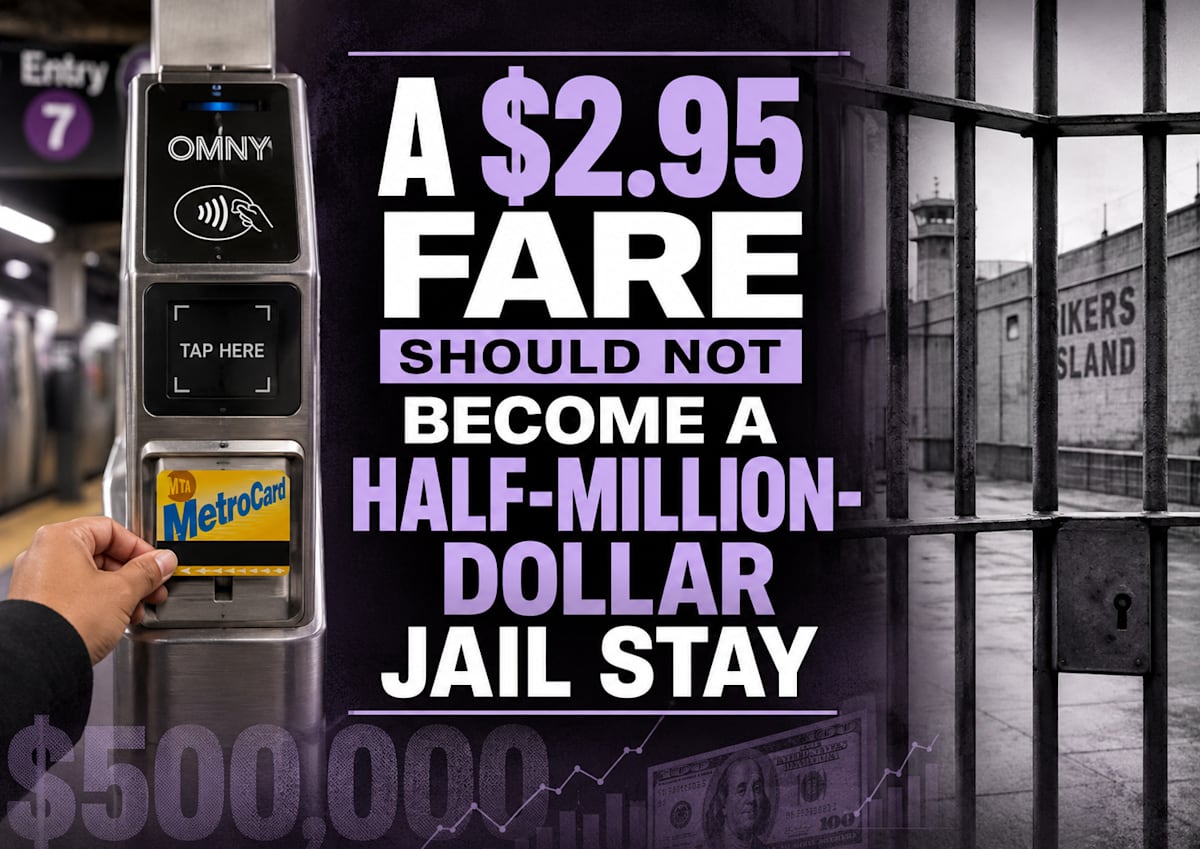
A $2.95 Fare Should Not Become a Half-Million-Dollar Jail Stay
92k0g9azosm5kam6mawsbg2jd6152.07 MBA $2.95 Fare Should Not Become a Half-Million-Dollar Jail Stay
By Michele Evans New York City, New York 6/26/2026
Category: Courts/ Criminal Justice / NYPD / Rikers Island
NEW YORK CITY, NY - At Thursday’s City Council hearing on improving court operations to reduce the jail population, one number stopped me cold.
Sixty-four percent.
That figure was floated during the hearing while advocates and officials discussed the people cycling through Rikers Island on lower-level, nonviolent, and poverty-linked cases. The official transcript and video were not yet posted as of publication, so the exact wording still needs confirmation.
But the policy question does not.
Why is New York City spending jail-level money on people whose cases often begin with poverty, homelessness, mental illness, subway enforcement, or court delay?
Make it make sense.
Because this is the part New York keeps trying to talk around: Rikers is not only a violence crisis. It is not only a staffing crisis. It is not only a closure deadline crisis.
Rikers is also an over-policing crisis.
When someone is arrested for fare evasion, the underlying conduct is a $2.95 subway ride. When a homeless person is accused of taking up too many seats on a train, the underlying issue is not public safety. It is homelessness. It is poverty. It is the failure of the city to provide somewhere safer for that person to sleep.
Yet the response too often starts with police, moves through arraignment, lands in a courtroom backlog, and can end with a jail bed.
That is how a $2.95 problem becomes a taxpayer-funded cage.
New York City has already documented the extraordinary cost of this system. The City Comptroller previously reported that the full annual cost of incarceration in New York City rose to $556,539 per person in Fiscal Year 2021. A later Comptroller report found DOC spent about $507,000 per person incarcerated on an annual basis in 2023.
That means New York can spend more than half a million dollars a year to detain one person.
Half a million dollars.
For one human being.
Now put that next to the types of low-level conduct that keep getting swept into the criminal legal system. Fare evasion. Subway survival behavior. Poverty. Mental health crises. Addiction. Missed court dates. Cases that stall. Discovery delays. People who are presumed innocent but trapped because the machinery moves too slowly.
That is not public safety.
That is fiscal insanity dressed up as law and order.
If the city can find more than $500,000 a year to cage one person, it can find money for housing. It can find money for mental health treatment. It can find money for supervised release. It can find money for court staffing, discovery access, transportation help, text reminders, treatment beds, reentry support, and actual intervention before the cage.
Instead, New York keeps choosing the most expensive, least humane option available.
At the hearing, I testified as an independent journalist, author, and Rikers survivor. I told the Council there is no reason people should be denied basic discovery access or forced to sit in jail while agencies blame vendors, staffing shortages, or broken systems. I also talked about the pressure created by extreme sentencing ranges, where people take pleas not because justice was done, but because the risk of fighting a case can feel unbearable.
That is the lived reality behind these numbers.
People do not experience court delay as a chart.
They experience it as missed birthdays. Lost jobs. Broken families. Medical neglect. Mental health deterioration. Fear. Pressure. Silence. Pleas. Survival.
And for the city, every delay carries a price tag.
The Comptroller has warned that longer court case processing times inflate New York City’s jail population and cost taxpayers nearly $1 billion annually. The same report found that felony cases in DOC custody taking more than three years to process increased by 179% from 2019 to 2023. Aligning case timelines with national best practices could reduce the number of jail beds needed and potentially save hundreds of millions of dollars each year.
So when city officials talk about reducing the jail population, they cannot keep pretending this is only about what happens after someone enters Rikers.
The front door matters.
Policing choices matter.
Transit enforcement matters.
Bail decisions matter.
Discovery delays matter.
Court calendars matter.
The question is not just how to move people through the system faster. The question is why so many people are being pulled into the system in the first place.
Because if the answer to a $2.95 fare is a half-million-dollar jail bed, the system is not broken in some accidental way.
It is functioning exactly as designed.
And that design needs to end.
*Michele Evansis an independent journalist, author, and former ESPN technical producer whose work has appeared in The New York Times.
Michele got her start in 2001 covering the NBA and NFL.
She now covers New York City courts, criminal-justice procedure, NYPD, FDNY, domestic-violence systems, media accountability, public safety, advocacy efforts, and New York civic life through courthouse observation, public records, legal analysis, and lived-experience reporting.