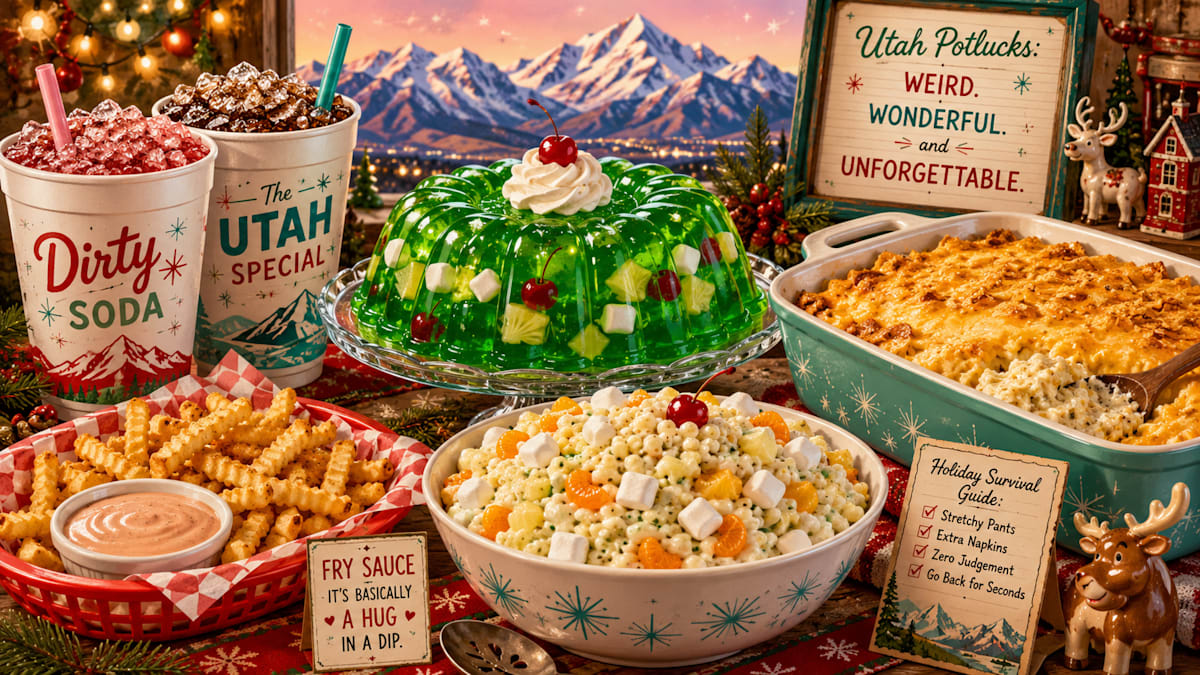
Utah has a food culture all its own. 🏔️
It is part pioneer pantry, part church potluck, part family reunion, part holiday table, and part “someone’s aunt definitely brought this in a glass casserole dish with foil over the top.”
It is sweet, creamy, salty, nostalgic, practical, and occasionally alarming to outsiders who are not emotionally prepared for marshmallows to appear in places they did not expect.
But that is the charm.
Utah holiday food is not trying to be sleek, coastal, or pretentious. It is food built for large families, ward gatherings, funeral luncheons, Christmas parties, Sunday dinners, and neighbors who show up with a pan of something warm because that is what people do when life gets hard.
These dishes are not just recipes. They are cultural artifacts.
They tell a story about thrift, community, abundance, comfort, and the strange glory of making something unforgettable out of pantry staples, canned fruit, whipped topping, potatoes, pasta, sugar, and faith.
So grab a paper plate, make room next to the casserole, and let us take a loving tour through Utah’s quirkiest holiday eats. 🍽️
Green Jell-O: The Wiggly Crown Jewel of Utah Cuisine 💚
No food is more famously tied to Utah than green Jell-O.
It is not merely a side dish. It is a symbol. It is a punchline. It is a point of regional pride. It has appeared at family dinners, church socials, holiday tables, and funeral luncheons for generations, often suspended with fruit, topped with whipped cream, or transformed into something that hovers somewhere between salad and dessert.
To outsiders, green Jell-O can be confusing.
Why is it served with dinner?
Why is it called a salad?
Why are there carrots in it?
Why does everyone seem so calm about this?
But in Utah, green Jell-O makes perfect sense. It is cheerful, inexpensive, easy to prepare for a crowd, and colorful enough to make any buffet table feel festive.
It is also endlessly adaptable. Lime Jell-O with pineapple. Lime Jell-O with cottage cheese. Lime Jell-O with shredded carrots. Lime Jell-O with marshmallows. Lime Jell-O with whatever someone’s grandmother decided was correct in 1978 and the family has never questioned since.
Green Jell-O is not about sophistication. It is about memory.
It tastes like holiday potlucks, church basements, plastic serving spoons, and someone saying, “Did you try Sister so-and-so’s salad?” while pointing at something that jiggles.
Funeral Potatoes: The Sacred Comfort Casserole 🥔🧀
If green Jell-O is Utah’s quirky mascot, funeral potatoes are its emotional support dish.
Creamy, cheesy, buttery, and usually topped with crunchy cornflakes or crushed potato chips, funeral potatoes are the casserole equivalent of someone putting a hand on your shoulder and saying, “You do not have to cook tonight.”
The name comes from the dish’s frequent appearance at post-funeral meals, especially in Latter-day Saint communities, where neighbors and church members often provide food for grieving families.
But funeral potatoes are not reserved for funerals. They show up at Easter, Christmas, Thanksgiving, family reunions, Sunday dinners, and basically any event where people need to be fed with love and carbohydrates.
The classic version usually includes shredded or cubed potatoes, cream soup, sour cream, cheese, butter, and a crunchy topping. It is not subtle. It is not light. It is not trying to be.
That is the point.
Funeral potatoes are comfort food in its most honest form. They are practical, filling, easy to transport, easy to reheat, and nearly impossible to dislike. They belong to the great American casserole tradition, but in Utah they have become something closer to edible community care.
A pan of funeral potatoes says:
I am sorry.
I love you.
Here is cheese.
Frog Eye Salad: The Dish With the Name Nobody Can Explain Gracefully 🐸
Then there is Frog Eye Salad, a dish that sounds like a dare but tastes like a sweet holiday memory.
Despite the name, no frogs are involved. The “frog eyes” are actually tiny round pasta, usually acini di pepe, mixed with fruit, whipped topping, marshmallows, and a sweet custard-like dressing. The result is a fluffy, creamy fruit-and-pasta salad that appears on holiday tables with complete confidence.
Frog Eye Salad is one of those dishes that reveals how flexible the word “salad” can become in Utah and across much of the Intermountain West.
Lettuce? Not required.
Vegetables? Optional.
Whipped topping? Absolutely.
Marshmallows? Naturally.
Pasta? Why not?
It is sweet, soft, nostalgic, and deeply tied to gatherings where the dessert table and side-dish table have never been fully separated. It belongs to the same family as ambrosia salad, Watergate salad, and all the other creamy fruit mixtures that somehow became part of dinner.
The name may be unfortunate, but the dish has staying power. It is weird in the way beloved family traditions often are: hard to explain, easy to recognize, and impossible to remove from the holiday rotation without someone asking where it went.
Fry Sauce: Utah’s Pink Condiment of Devotion 🍟
No Utah food guide would be complete without fry sauce.
At its simplest, fry sauce is a mixture of ketchup and mayonnaise. But reducing it to that description feels almost disrespectful. In Utah, fry sauce is not merely a condiment. It is a regional identity marker.
It goes with fries, burgers, onion rings, tots, chicken tenders, and probably several things no one needs to admit publicly. It is creamy, tangy, slightly sweet, and perfectly suited to the kind of comfort food Utah does best.
Many families and restaurants have their own versions. Some add pickle juice. Some add barbecue sauce. Some add garlic powder, hot sauce, or secret ingredients passed down with the seriousness of a family Bible.
Fry sauce is simple, but that is its genius. It turns a basket of fries into an event. It is humble, useful, and oddly addictive — the kind of thing people miss when they move away and then try to recreate in other states while explaining, “No, you don’t understand, it’s a Utah thing.”
And they are right.
It is.
Dirty Sodas: Utah’s Fizzy Little Rebellion 🥤✨
And then, of course, there are dirty sodas — the unofficial beverage of Utah errands, church parking lots, school pickups, and women who can run a household, organize a Relief Society activity, and customize a Diet Coke like it is a sacred art form.
Made famous by shops like Swig, dirty sodas are exactly what they sound like: soda, but dressed up, flirted with, and sent out into the world with confidence.
Think Diet Coke with coconut cream and lime. Dr Pepper with raspberry and vanilla. Sprite with peach, mango, or whatever combination feels spiritually correct in the moment.
In a state where alcohol and coffee have long carried cultural baggage, the dirty soda became its own kind of social ritual: a sweet, fizzy treat that lets everyone have a “special drink” without crossing any lines. It is part beverage, part personality test, and part Utah love language.
And yes, Mormon housewives helped make them iconic. The dirty soda run is not just about thirst. It is about community, reward, routine, and a tiny cup of rebellion with pebble ice.
A Utah holiday spread may have funeral potatoes, green Jell-O, fry sauce, and Frog Eye Salad — but somewhere nearby, there is probably also a giant insulated cup sweating gently on the counter, filled with something carbonated, creamy, and aggressively customized.
Because in Utah, even the soda has a testimony. 🥤
Comfort Casseroles: The True Language of the Potluck 🥘
Utah’s holiday food culture thrives on the casserole.
This makes sense. Casseroles are practical. They feed a crowd. They can be made ahead of time. They travel well. They sit patiently on buffet tables. They can be stretched, doubled, frozen, reheated, and delivered to a neighbor in need.
The comfort casserole is not just food. It is infrastructure.
Chicken and rice casserole.
Tater tot casserole.
Ham and potato casserole.
Green bean casserole.
Creamy noodle casseroles.
Cheesy vegetable casseroles.
Mystery casseroles whose exact contents are known only to the person who brought them and possibly the Lord.
These dishes reflect a culture where feeding people is a form of service. When someone has a baby, someone brings a casserole. When someone dies, someone brings a casserole. When there is a ward Christmas party, someone brings three casseroles and labels none of them.
Holiday casseroles are not about culinary perfection. They are about abundance, warmth, and making sure no one leaves hungry.
That matters.
There is a kind of generosity in food that can be made in a 9-by-13 pan and handed to someone without requiring explanation.
Why So Much Sweetness? 🍬
One of the first things outsiders notice about Utah holiday food is how sweet everything can be.
Sweet salads.
Sweet potatoes with marshmallows.
Sweet drinks.
Sweet rolls.
Sweet Jell-O.
Sweet fruit-and-cream dishes served next to ham, turkey, or potatoes.
Part of this comes from mid-century American food trends, when convenience products, gelatin molds, canned fruit, boxed mixes, and whipped toppings became symbols of modern homemaking. Utah embraced those trends and, in many cases, preserved them with unusual devotion.
But there is also something cultural at work.
In communities where alcohol and coffee may be avoided for religious reasons, sugar often becomes the socially acceptable indulgence. Dessert is not just dessert. Soda is not just soda. A sweet holiday salad is not just a side dish. These foods become treats, rewards, rituals, and shared pleasures.
Utah food culture has a sweet tooth because sweetness has long had permission to be public.
The Pioneer Pantry Meets the Church Basement ⛪
Utah’s quirkiest foods did not appear out of nowhere.
They come from a blend of pioneer practicality, Latter-day Saint community life, western resourcefulness, and 20th-century convenience cooking. Shelf-stable ingredients mattered. Food storage mattered. Feeding large families mattered. Feeding large groups mattered.
That history helps explain the importance of canned fruit, potatoes, gelatin, pasta, cream soups, powdered mixes, and casseroles. These were ingredients that could be stored, stretched, and transformed.
The church basement also shaped the cuisine. Potlucks reward dishes that are affordable, transportable, recognizable, and crowd-friendly. Foods that might seem strange in a restaurant make perfect sense on a long folding table next to rolls, ham, paper plates, and a Crock-Pot full of meatballs.
Utah holiday food is not restaurant food. It is gathering food.
That distinction explains almost everything.
Why These Foods Still Pack A Punch❤️
It is easy to laugh at green Jell-O, Frog Eye Salad, funeral potatoes, dirty sodas, and the endless parade of casseroles.
Honestly, some of the laughter is earned.
But these foods endure because they carry memory. They belong to grandmothers, ward kitchens, family traditions, neighborhood kindness, and holiday tables where someone always made too much because making too much was the point.
They are funny, yes.
They are quirky, absolutely.
But they are also deeply human.
They represent a culture that believes food should be shared, that grief should be fed, that holidays should be abundant, and that even the oddest dish can become beloved if enough generations keep bringing it to the table.
So yes, Utah’s holiday eats can be unusual. They can be creamy, jiggly, fizzy, cheesy, and occasionally difficult to categorize.
But they are also generous.
And in the end, that may be the most Utah ingredient of all.
Classic Utah Funeral Potatoes Recipe 🥔🧀✨
Because no field guide to Utah comfort food should end without the casserole that shows up when people are celebrating, grieving, gathering, or simply hungry.
Ingredients
- 1 bag frozen shredded hash browns, thawed
- 1 can cream of chicken soup
- 1 cup sour cream
- 2 cups shredded cheddar cheese
- 1/2 cup melted butter
- 1/2 cup chopped onion, optional
- Salt and pepper to taste
- 2 cups crushed cornflakes or crushed potato chips
- 2 tablespoons melted butter for topping
Instructions
Preheat oven to 350°F.
In a large bowl, mix the hash browns, cream of chicken soup, sour cream, cheddar cheese, melted butter, onion, salt, and pepper until well combined.
Spread the mixture into a greased 9-by-13-inch baking dish.
In a separate bowl, toss the crushed cornflakes or potato chips with the remaining melted butter. Sprinkle evenly over the top.
Bake for 40 to 50 minutes, or until the casserole is hot, bubbly, golden on top, and smells like someone in Utah loves you.
Serve warm, preferably next to ham, rolls, green Jell-O, and at least one person explaining that their version is better because they use extra cheese.
Because in Utah, comfort is often delivered in a casserole dish - and funeral potatoes may be the holiest pan of all.
Enjoy the holiday Mormon Wives Style 👍👀💯
#UtahFood #FuneralPotatoes #GreenJello #FrogEyeSalad #DirtySoda #Swig #FrySauce #ComfortFood #HolidayEats #MormonCulture #UtahTraditions #CasseroleLife